
Blask has just released its Fantasy Sports 2026 report—the first comprehensive study of this category—covering 100 countries and all 50 U.S. states over the period from July 2025 to July 2026. The report’s release coincides with the August 21st kickoff of the Premier League’s 2026–2027 season. Additionally, the NFL season opener is scheduled for September 9th, creating a peak season that drives global demand for fantasy sports.
Market Overview
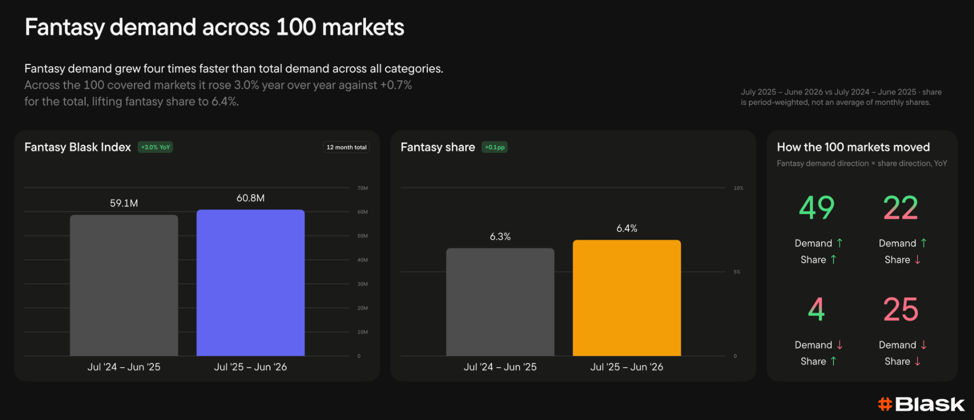
Overall demand for iGaming rose by 0.7% year-over-year, with the aggregate Blask Index climbing from 59.1 million to 60.8 million. Fantasy sports outperformed the broader market, growing by 3% and increasing its market share to 6.4%.
However, in 2025, the expansion of fantasy sports had lagged behind lotteries and regional events. By 2026, the picture had changed significantly: growth was more balanced, with both demand and market share rising in 49 countries, while only 25 countries saw a decline. Meanwhile, 22 countries experienced increased demand alongside a contraction in market share, indicating that the category is undergoing a structural shift rather than experiencing an isolated, short-lived spike.
Driven by mobile apps, real-time data feeds, and social competition, the 18–34 demographic has become the core participant group. The 35–54 age group maintains a balance between fantasy sports and traditional betting. As for those aged 55 and older, while they generally favor lotteries and casual gaming, their participation is gradually rising in markets where soccer is the primary focus.
Gender dynamics are also reshaping the market, with an increasing number of female participants joining mainstream leagues—particularly in low-barrier, community-driven competitions. Tournament Impact
Fantasy sports have frequently been affected by the rescheduling of major events such as the World Cup and EURO 2024. Yet, despite these disruptions, the sector achieved 3% annual growth—four times the rate of the overall market. This resilience highlights its ability to withstand fluctuations in the sporting calendar.
Regional Highlights
Among the mid-sized European markets driving growth, Lithuania (100%), Romania (94%), and Hungary (90%) all recorded near-triple-digit increases. Meanwhile, the UK and the US remain the market leaders by volume, together accounting for 40% of global demand for fantasy sports.
The report notes a divergence between scale and growth: the largest markets are not necessarily the fastest-growing, reflecting the varying stages of market maturity.
Technology and Innovation
Mobile-first platforms are driving the popularity of fantasy sports by offering real-time data, instant lineup adjustments, and push notifications. Younger demographics, for instance, show higher levels of engagement through these experiences.
Emerging technologies are also transforming the sector as blockchain platforms are introduced. These enable transparent scoring for tokenized rewards and player cards linked to NFTs. Such features appeal to tech-savvy users and enhance credibility within regulated markets.
Furthermore, AI-driven tools provide predictive insights, lineup optimization, and injury risk modeling, helping fantasy sports evolve from a purely casual pastime into a more data-driven, strategic game.
Regulatory Landscape
Fantasy sports have continued to grow despite the tightening of gambling regulations across multiple jurisdictions. In Europe, licensing and tax regimes have become stricter; for instance, the UK has doubled its Remote Gaming Duty.
Brazil has solidified its new regulatory framework, while emerging markets such as Finland and the Philippines are preparing competitive licensing systems—signaling a shift in how operators approach expansion and strategic adjustments.